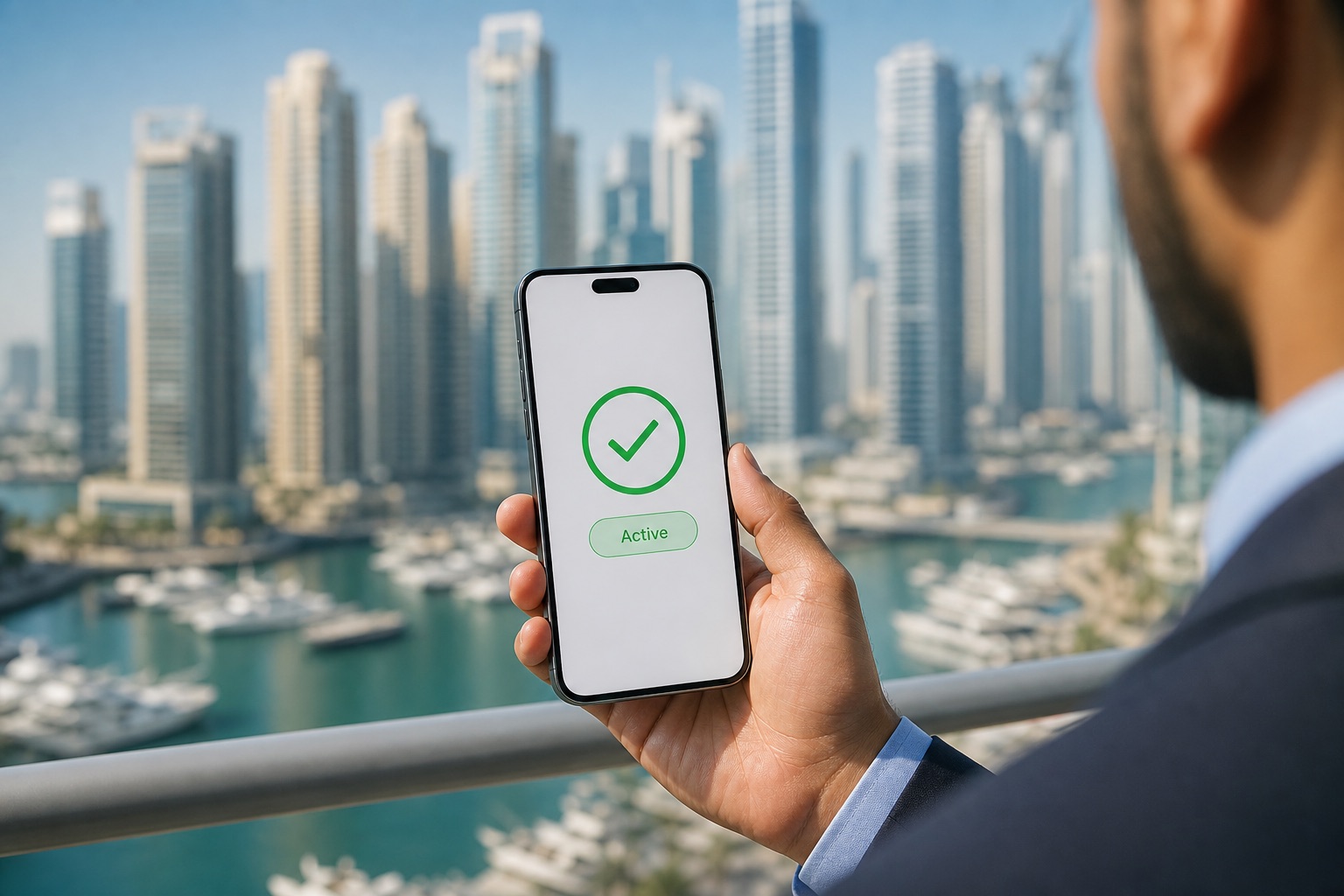
To find a good real estate agent in Dubai, check five things: the agent’s broker card (BRN) and office registration (ORN) on the Dubai Land Department’s Dubai REST app, a valid advertising permit on the listing, a signed written brokerage agreement, the fee and when it is due, and a proven track record in your area.
Dubai regulates property brokers closely, and almost everything an agent tells you about their licence can be checked in a few minutes, free, on official systems. This guide takes you through the five checks in order, with the rules behind each one, then covers red flags, how to complain, and how to use a ranked shortlist without taking anyone’s word for it.
The five checks at a glance
| Check | What to look for | Where to check |
|---|---|---|
| 1. Licence | A current broker card (BRN) and a licensed office (ORN) | Dubai REST app; DLD licensed brokers and brokerage companies lists |
| 2. Listing | A Trakheesi advertising permit and QR code on the advert | DLD “Verify License and Permits” service; scan the QR code |
| 3. Agreement | A written brokerage agreement naming both parties, the property and the terms | The contract itself (DLD standard forms) |
| 4. Money | The fee, who pays it, VAT and when it becomes due, all in writing | Your brokerage agreement |
| 5. Track record | Recent deals in your community and property type; how they treat clients | References, Dubai REST office classification, independent rankings |
Step 1: Is the agent licensed? Check the BRN and ORN
In Dubai you cannot legally work as a property broker without a licence and a registered broker card. DLD’s own guidance says no individual may practise brokerage before applying for a licence through RERA, the regulatory arm of DLD, and that a broker “must be registered in the brokers registry and hold a broker card from the Real Estate Regulatory Agency”.
What is a BRN?
The BRN is the Broker Registration Number: the number of the individual agent’s registration in the brokers registry. It appears, labelled “BRN”, on DLD’s standard brokerage agreements next to the broker’s name.
What is an ORN?
The ORN is the Office Registration Number: the registration of the brokerage company the agent works for. DLD’s standard agreements list it with the company name and commercial licence number. A brokerage office is registered automatically when its licence is issued.
How to check them
- Dubai REST app. DLD’s “E-card verification” service lets you choose the card type and enter the card number to verify a card issued by RERA. The app also shows details of brokers, their performance levels and the classification of real estate offices.
- DLD website. DLD publishes the list of licensed real estate brokers and the list of licensed brokerage companies.
What a valid card tells you: to get one, an agent needs a Dubai Police certificate of good conduct and must have passed the broker exam, and the card’s validity is tied to the validity of the office’s trade licence. If the office’s licence lapses, so does the agent’s card. Check the name, photo and office on the card match the person in front of you.
A genuine agent will give you their BRN without hesitation. Reluctance is itself useful information.
Step 2: Is the listing genuine? Look for the permit and QR code
Brokers cannot simply post a property online. Advertising a property in Dubai needs a permit issued through DLD’s Trakheesi system, and for online and classified adverts the broker must hold a marketing contract with the owner.
- Form A is linked to the permit. Since 1 August 2022, RERA has linked real estate advertising permits to the seller’s e-marketing contract (Form A), so a properly advertised resale property should have a signed Form A behind it (RERA Circular 01-2022).
- Every advert must carry a QR code. Since 15 April 2023, all real estate companies must show the Trakheesi QR code on their adverts, in print or audio-visual form, so customers can check the advert is valid and approved by RERA. The fine for not doing so is AED 50,000 (RERA Circular 02-2023).
- Stale adverts must come down. RERA requires offices to remove adverts for properties no longer available within 7 working days, and fines offices that do not.
You can check a permit using DLD’s Verify License and Permits service. A listing with no permit number or a QR code that points to a different company or property is unverified at best, and a bait listing at worst.
Step 3: Get the agreement in writing
Dubai’s brokerage rules come from Bylaw No. 85 of 2006, which set up the Real Property Brokers Register. Article 26 says a brokerage agreement must be in writing and must state the names of the parties, the specifications of the property and the brokerage terms. DLD adds that the contract should show the parties, the property, the agreed amount, the commission rate and the date of registration with DLD.
The main documents you are likely to see:
| Document | Between | What it does |
|---|---|---|
| Form A | Seller and broker | RERA’s e-marketing contract. It authorises the broker to market the property and is linked to the advertising permit. |
| Form B | Buyer and broker | Appoints a broker to act for the buyer and records the agreed fee. |
| Form F (Contract F) | Buyer and seller | DLD’s standard sale contract: price, deposit, payment terms, transfer date, and how the 4% DLD transfer fee is split. |
| Lease brokerage agreements | Owner and broker; broker and tenant | DLD standard forms for rentals, each showing the ORN, BRN and the commission payable by the owner and/or the tenant. |
Agreements can be exclusive or non-exclusive. DLD’s guidance is that under an exclusive agreement the property cannot be offered through another broker, while a non-exclusive agreement allows several. Before you sign, check that the BRN and ORN on the agreement match what you verified in step 1.
Step 4: Know what you will pay, and when
No law fixes the rate. Under Article 27 of Bylaw 85, the broker’s fee is set by agreement, and only if there is no agreement is the prevailing custom used. Three other rules in the bylaw matter to clients:
- When the fee is earned. A broker is entitled to the fee only if the brokerage leads to a contract, and becomes entitled to it on signing the sale contract and registering it with DLD, unless the agreement says otherwise (Article 28).
- Who pays. A broker is entitled to a fee only from the party who engaged them (Article 33).
- Conflicts. A broker forfeits the fee if they act in the other party’s interest against their own client (Article 23), and must disclose negotiation details to their client (Article 17).
VAT is charged at the UAE’s standard 5% on taxable services, so a VAT-registered brokerage adds it to its fee. Separately, the DLD registration fee on a sale is 4% of the price; DLD’s fee schedule shows it as 2% for the seller and 2% for the buyer, and Contract F lets the two sides agree the split. Our guide to real estate commission in Dubai covers rates and negotiation in detail.
Step 5: Judge competence, not just compliance
A licence tells you an agent is allowed to work. It does not tell you they are good. For that, ask:
- How many sales or lettings have you done in this community and this property type in the past year? Can you show me recent comparable prices?
- Are you acting for me, for the other side, or both? How is your fee split with any other broker?
- Walk me through every cost from offer to transfer: DLD fee, trustee fee, developer no-objection certificate (NOC), mortgage costs.
- For off-plan: which projects do you know well, and can you show me the project’s status on Dubai REST?
- Can I speak to two recent clients?
Local depth matters more than generic enthusiasm. If you are buying or renting in one of the busiest areas, our area shortlists are a quicker starting point: Business Bay, Dubai Marina, Downtown Dubai, JVC, International City and Bur Dubai. Selling? See brokers who sell in your area.
Red flags that should make you walk away
- No BRN, or a card that does not verify.
- An advert without a permit or QR code, or a QR code that points to a different company or property.
- Unsolicited calls to owners. Since February 2026, RERA prohibits brokerage offices from obtaining owners’ data by unlawful means and from contacting owners or investors by phone or other channels to offer, market or buy property, unless they are existing documented clients. Penalties include a fine of AED 50,000 or a three-month suspension, and repeat offenders can lose their registration (RERA Circular 02-2026).
- A deposit paid into a personal account or outside a written contract. Under Article 21 of Bylaw 85 a broker holds money handed to them as a trustee, and under DLD’s Contract F the buyer’s deposit cheque is held in trust and cannot be cashed without both parties’ written instruction.
- Vagueness about the fee, or a request for payment before anything is signed.
- Prices well below the market for a property that is “just sold” when you call.
How to report an agent
You can file a complaint against a real estate company on the DLD website or in the Dubai REST app. DLD’s conditions are that the company is licensed in Dubai, the complaint is about a regulatory violation rather than a contractual claim, and you attach evidence such as the advert, payment receipt and ID. DLD does not handle refunds, reservation cancellations or other contractual disputes, or disputes over contracts concluded more than six months earlier; rental disputes go to the Rental Disputes Center.
Using a ranked shortlist
Checking one agent is quick. Choosing among thousands is the hard part. Top Realtors keeps a directory of 130+ ranked Dubai brokerages, and our homepage shows the top 10 real estate brokers in Dubai. How we rank: a valid RERA registration is a condition of being listed at all; each brokerage then gets an Expert Rating out of 5, weighted most heavily on track record and service quality, with Google ratings, service breadth, area coverage and market presence as supporting signals. Placement is not for sale.
Treat any ranking, including ours, as a starting point. Run the five checks on whoever you shortlist.
Frequently asked questions
How do I find a good real estate agent in Dubai?
Start with a shortlist of licensed brokerages that work in your area, then check each agent’s broker card (BRN) and office registration (ORN) on the Dubai REST app, confirm the advert has a Trakheesi permit and QR code, sign a written brokerage agreement that states the fee, and ask for recent deals and references in your community.
What does BRN mean in Dubai real estate?
BRN stands for Broker Registration Number, the number of an individual agent’s registration in Dubai’s brokers registry. It appears next to the broker’s name on DLD’s standard brokerage agreements, and you can verify the agent’s card in the Dubai REST app.
What is an ORN number in Dubai?
ORN stands for Office Registration Number, the registration of the brokerage company an agent works for. DLD’s standard agreements show it with the company’s name and commercial licence number, and DLD publishes a list of licensed brokerage companies on its website.
How much commission does a real estate agent charge in Dubai?
There is no legally fixed rate. Under Bylaw No. 85 of 2006 the fee is whatever you agree in writing, and custom applies only if nothing was agreed. The fee is normally earned once the sale contract is signed and registered with DLD, and VAT at 5% is added by VAT-registered brokerages.
How do I report an unlicensed or misbehaving agent in Dubai?
File a complaint against the real estate company on the DLD website or in the Dubai REST app, with evidence such as the advert and payment receipts. DLD handles regulatory violations by licensed companies; contractual disputes and refund claims go to the courts, and rental disputes to the Rental Disputes Center.
Which Dubai brokers have the best reputation?
Reputation depends on the area and property type. Our directory ranks 130+ RERA-registered brokerages by an Expert Rating weighted on track record and service quality, with Google ratings as a cross-check; see the Top 100 list and our methodology, then run the five checks on your shortlist.
Sources
- Dubai Land Department: Frequently asked questions (brokers registry, broker card validity, brokerage contract contents, exclusive agreements, complaints)
- DLD: Issuance of a real estate professional practice card (good-conduct certificate, broker exam, card validity tied to the trade licence)
- DLD: E-card verification (checking a broker card in Dubai REST)
- DLD: Licensed real estate brokers and Licensed real estate brokerage companies
- DLD: Real Estate Ad Permit (Trakheesi) (marketing contract with the owner required for advertising permits)
- DLD: Verify License and Permits
- DLD: Rules and regulations (RERA circulars 01-2022 on Form A and permits, 02-2023 on QR codes, 02-2026 on cold calling, and the 2022 circular on outdated portal adverts; DLD standard lease brokerage agreements)
- DLD: Real Estate Legislation (2019 compilation) (Bylaw No. 85 of 2006 Regulating the Real Property Brokers Register, Articles 17, 21, 23, 26–28 and 33)
- DLD: Property Sale Registration (4% fee shown as 2% seller, 2% buyer)
- DLD: Real Estate Complaints
- DLD: Dubai REST (broker performance levels and office classification in the app)
- UAE Government portal: Value Added Tax (standard rate 5%)
Leave a Reply