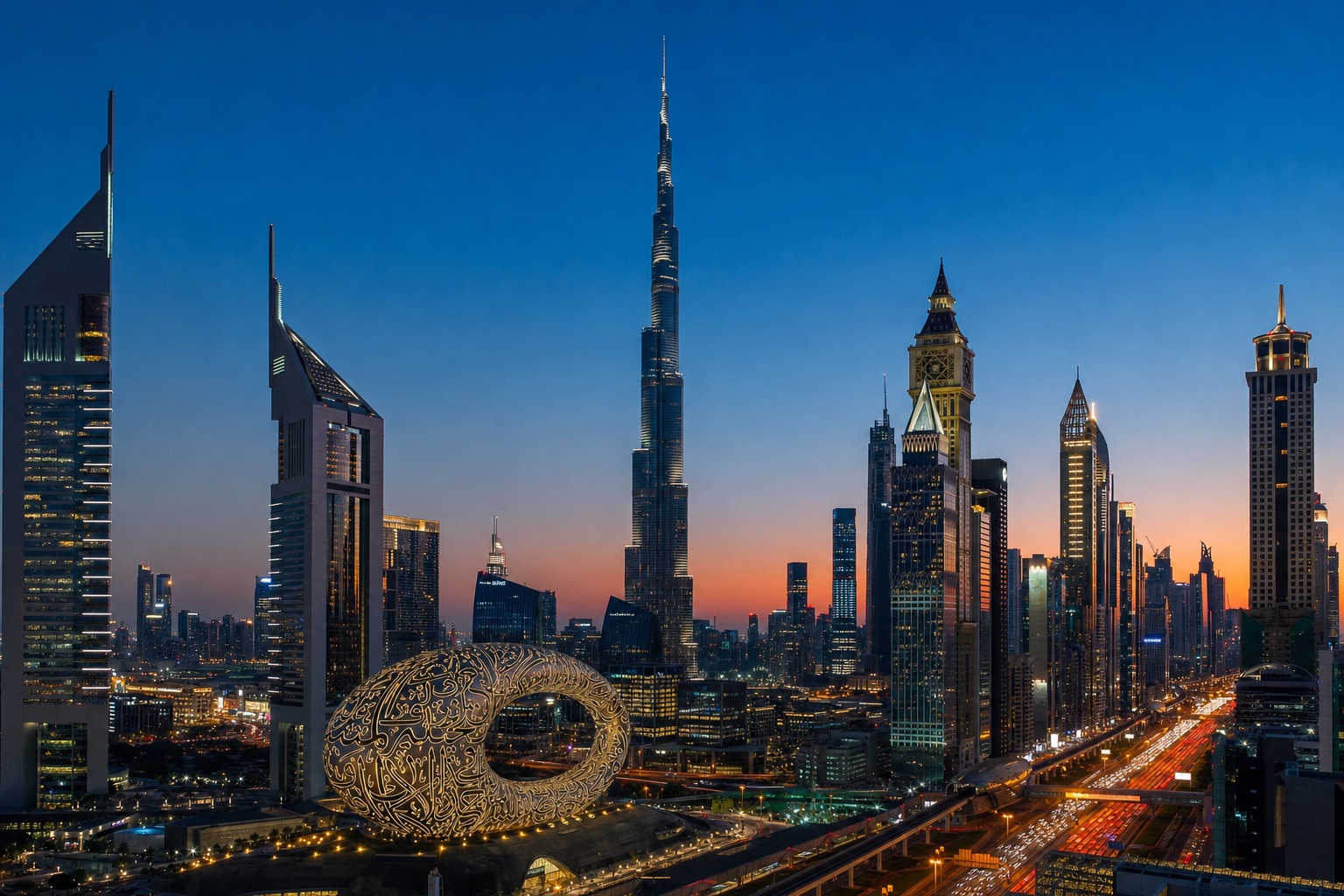
Dubai is one of the few cities on earth where the skyline reads like a portfolio. Almost every silhouette on the horizon is a signed work — a deliberate idea by a named architect, commissioned by a named developer, built to be recognised from a moving car at 120 km/h. Understanding who drew these buildings is one of the most useful things a property buyer can do, because the firms behind the landmarks are very often the same firms shaping the residences now selling off-plan.
This is our editorial guide to the architects and developers behind Dubai’s most iconic buildings, as of 2026 — verified attribution by attribution, with a note on the contemporary design studios quietly defining how the city actually lives indoors.
Burj Khalifa: the tower that set the template
The world’s tallest building was designed by Skidmore, Owings & Merrill (SOM) of Chicago, with Adrian Smith as design partner and Bill Baker as chief structural engineer. Smith’s tapering, three-lobed footprint was inspired in part by the Hymenocallis (spider lily), and its Y-shaped plan was engineered to “confuse the wind” — a buttressed core system that lets the tower step inward as it rises. The developer was, and remains, Emaar Properties, which built the entire surrounding Downtown district around it.
Two design names live inside Burj Khalifa as well. The Armani Hotel Dubai and the Armani Residences — occupying the concourse level up to the 39th floor and several residential levels above — were styled by Giorgio Armani, using the Armani/Casa line, in a partnership with Emaar. So the world’s most famous tower is, in effect, two signatures stacked: SOM’s exterior, Armani’s interior.
Burj Al Arab: the sail that became a logo
The hotel that put Dubai on tourist mugs and number plates was designed by Tom Wright of Atkins (now part of AtkinsRéalis). The brief was explicit: create an icon as instantly legible as the Sydney Opera House. Wright answered with the profile of a billowing dhow sail, clad in a translucent fibreglass screen that shields the atrium by day and becomes a lighting canvas by night. Conceived in 1994 and completed in 1999 for Jumeirah, it remains the textbook example of architecture-as-branding.
Museum of the Future: a torus full of poetry
The calligraphy-wrapped ring on Sheikh Zayed Road is the work of Killa Design, the Dubai studio founded by architect Shaun Killa. Before going independent, Killa was director of architecture at Atkins, where he worked on the Bahrain World Trade Center. The Museum’s torus form has no traditional internal columns — it stands on a steel diagrid — and the Arabic script across its façade renders quotes from Sheikh Mohammed bin Rashid Al Maktoum on the future. It is one of the clearest cases of a homegrown Dubai practice producing a globally recognised landmark.
The Opus: Zaha Hadid’s cube with a hole in it
In Business Bay, The Opus is a near-perfect cube with a fluid void carved through its centre — designed by Zaha Hadid Architects for developer Omniyat and completed in 2019. It is one of the rare projects for which Zaha Hadid designed both the architecture and the interiors (it houses the ME Dubai hotel). Two orthogonal blocks are linked by a three-storey bridge 71 metres up, with the eroded glass void giving the whole thing its signature jewel-box quality.
Engineering as spectacle: One Za’abeel and Cayan Tower
Two of Dubai’s most technically audacious towers exist mainly to show what is structurally possible.
One Za’abeel, designed by the Japanese firm Nikken Sekkei for Ithra Dubai, is joined by The Link — a sky-bridge that holds the Guinness World Records title for the world’s longest cantilevered building, with a 66-metre overhang sitting around 100 metres above the road. Completed in 2023, it houses a One&Only hotel and the SIRO fitness hotel.
In Dubai Marina, Cayan Tower — launched as Infinity Tower — was designed by SOM for Cayan and completed in 2013. Each of its floor plates rotates 1.2 degrees on the one below, producing a full 90-degree twist over 75 storeys. The spiral is not decoration: it reduces wind load and reorients each apartment’s view from the Marina up to the Gulf.
The pioneers: Emirates Towers and the Dubai Frame
Before the 2000s building boom, Jumeirah Emirates Towers set the bar. The twin towers were designed by architect Hazel Wong while at NORR, completed in 2000, and are frequently cited as among the tallest skyscrapers designed by a woman at the time of completion — an important and often-overlooked credit in the city’s story.
The Dubai Frame in Za’abeel Park has a more complicated origin. Its design won the 2009 ThyssenKrupp Elevator international competition for Mexican architect Fernando Donis, whose concept was to “frame” the city rather than add another monument to it. The built project was delivered by Hyder Consulting (part of Arcadis) and opened in 2018, and Donis publicly disputed his credit and compensation in litigation — so while the winning design is firmly attributed to Donis, the authorship of the finished structure has been contested.
When developers hire global names
Two recent landmarks show how Dubai’s developers now shop internationally for signature architecture:
- Atlantis The Royal on Palm Jumeirah was designed by Kohn Pedersen Fox (KPF) for Kerzner International, opening in 2023. Its six towers stacked into a permeable, offset lattice — with a sky pool bridging the gap — were a deliberate attempt to redraw the Palm’s skyline.
- Dubai Opera in Downtown was designed by Janus Rostock of Atkins for Emaar, opening in 2016. Its dhow-shaped form nods, like Burj Al Arab, to Dubai’s seafaring past — the “bow” holds the auditorium, the “hull” the public spaces.
For buyers, the pattern matters: the developers behind Dubai’s most iconic buildings — Emaar, Omniyat, Meraas, Nakheel, Kerzner — tend to reuse the same calibre of design talent on their residential launches. Architecture is one of the most reliable signals of a project’s positioning.
From global icons to Dubai’s own studios
Skyline icons get the headlines, but the next layer of the city’s story is being written by studios based in Dubai itself — practices now winning architectural mandates on landmark-grade projects.
One example is MOMA International Design, a multidisciplinary studio in Dubai Design District (d3) working across architecture, interior design and landscape (with a bespoke furniture line, MAUVE by MOMA). As of 2026, MOMA is the lead architectural designer of the Gran Meliá Hotel at Port de La Mer — a 366-key, five-star beachfront resort within Meraas’s Port de La Mer, developed by ASB Investment and set to be operated by Meliá Hotels International under its Gran Meliá brand, on track to complete by the end of 2026. (The hotel’s interiors are by a separate firm, Lagranja Studio — a reminder of how many specialist hands shape a single building.)
It illustrates the article’s central point: in Dubai, landmark-grade architecture is no longer the preserve of imported super-firms — homegrown studios are now designing the buildings people will stay in and live in. If branded residences and design pedigree are what you care about, our guide to luxury real estate in Dubai maps where these standards show up in the current market.
Why this matters when you buy
Reading a building’s authorship is a form of due diligence. A signed architect, a credible developer and a named interior studio together tell you how a project is positioned, who it is built for, and how it is likely to hold value. Whether you are tracking the top off-plan developers in Dubai or comparing the city’s most established names on our Top 100 directory, the architecture is rarely an accident — it is the strategy, made visible.
Looking to buy into a project with genuine design pedigree? Browse vetted, independent brokers on the Top Realtors directory and ask them which architect and developer stand behind any building before you commit.
Frequently asked questions
Who designed the Burj Khalifa?
The Burj Khalifa was designed by Skidmore, Owings & Merrill (SOM), with Adrian Smith as design partner and Bill Baker as chief structural engineer. It was developed by Emaar Properties and completed in 2010.
Which architect designed the Museum of the Future?
The Museum of the Future was designed by Killa Design, the Dubai-based studio founded by architect Shaun Killa. Its torus shape uses a column-free steel diagrid and an Arabic-calligraphy façade.
Did Zaha Hadid design a building in Dubai?
Yes. Zaha Hadid Architects designed The Opus in Business Bay for developer Omniyat, completed in 2019 — one of the rare projects where Zaha Hadid designed both the architecture and the interiors. It houses the ME Dubai hotel.
What is the world’s longest cantilever building in Dubai?
One Za’abeel, designed by Nikken Sekkei for Ithra Dubai, holds the Guinness World Records title for the longest cantilevered building via its sky-bridge, “The Link,” completed in 2023.
Leave a Reply